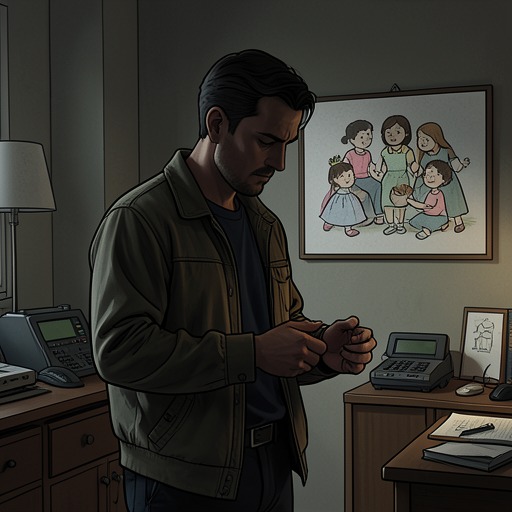
Peter and Eva’s Marital Crisis
Nieuwe burenPeter and Eva’s Marital Crisis grows from a shared loss into a conflict over how to grieve, whether to seek help, and what parenthood and fidelity should mean. Peter wants to endure pain by moving on; Eva insists that their marriage and their future require change. Their efforts to stay together bring them into therapy and medical treatment, but also into choices made without mutual agreement. The relationship becomes a site where love, fear, bodily autonomy, and the desire for a child pull in opposing directions.
Grief, Therapy, and Resistance
Eva describes Peter as someone who handles unexpected change badly: when something happens that he could not anticipate or prepare for, he becomes overwhelmed. She says this has left her feeling that she must be the strong one and keep everything moving, and that she can no longer do so. Her matter-of-fact account to Hetty Vos makes the imbalance plain, but Peter experiences the therapy itself as another change imposed on him. Eva has made the appointment without consulting him and gives him the choice of attending or separating. He resents the pressure and privately regards the practice as an alien, unpleasant place where he does not want to talk.
At their meeting, Peter refuses Hetty’s request to take off his shoes. The refusal has little to do with the shoes themselves: in that room, he feels that complying would mean surrendering. He says he is participating for Eva and to save their marriage, not because he trusts therapy. Hetty recognizes his anger and lack of trust, describing him as if he were a child sent against his will. Peter partly accepts the description. He believes their loss was terrible bad luck and that, at some point, they simply have to carry on; he doubts that a stranger can help them do so. He also worries that therapy may pull Eva deeper into despair rather than help her.
His resistance becomes a point of conflict in its own right. After Peter tells Eva he has stopped seeing Hetty, she withdraws from him. While she silently prepares for an evening barbecue with Rebecca and Steef, Peter carries in the heavy shopping, puts it away, prepares sauces, and repeatedly asks whether she needs anything. He would rather face open anger than the sustained silence he associates with her way of fighting. Yet he decides not to return to therapy, even if she continues to ignore him. His caretaking and defiance coexist: he tries to ease the immediate tension while refusing the step Eva believes the marriage needs.
Infertility and the Pressure to Conceive
The couple’s distress is also shaped by the long effort to have a child. After a year of trying, their doctor tells them that half of couples will be pregnant by then and half will not, and sees no immediate reason for alarm. He recommends tracking Eva’s basal temperature to help time intercourse. The routine brings fertility into the most intimate details of their days: Eva takes her temperature at half past six each morning, and a rise of 0.2 degrees Celsius suggests that ovulation may be near. Sex becomes scheduled around that possibility, while kissing and lingering are sometimes unwelcome because they are short of time before work.
The routine does not bring the couple closer. After another six months, they argue about whether to enter fertility treatment. Peter wants a child with Eva, but resists the idea of one conceived through a medical procedure. He misses their former intimacy and tells her that sex has become automatic for three days a month, with little or none the rest of the time. Eva feels betrayed by his reluctance to continue. Her longing for a child, she says, has taken over her life; she also argues that testing might uncover a manageable problem that they would be foolish not to investigate.
They do proceed to a gynecologist. Eva’s examination reveals no obvious abnormalities: her chart indicates monthly ovulation, and the scan finds no blockages, cysts, or inflammation in her uterus or ovaries. Peter provides samples for two semen tests, with a five-day period without ejaculation before the first. Both tests show low sperm count and poor motility. The findings leave them facing fertility treatment as the only apparent medical route to having a child. The discovery deepens the crisis beyond a disagreement about procedure: the difficulty is connected to Peter’s body, while the treatment and its demands affect both partners and their sexual relationship.
Love, Intimacy, and the Fear of Separation
At the beach, Eva questions whether the couple’s devotion to having a child has kept them from asking whether they belong together or want the same life. Peter rejects her framing. He says she is speaking for herself, objects that she has raised these doubts during what he sees as their first beach outing in years, and asks whether she doubts his love. When she says the matter is not simple, he answers by listing what he sees as his concessions: he loves her, has built her a house with the things she wants, accepts their limited sex life, forgives her for letting a neighbor touch her sexually, and went to therapy at her request.
The list is a declaration of commitment, but it also shows how Peter understands the marriage—as a record of what he has done or tolerated to keep Eva. His anger shifts into fear when he realizes that her talk of living differently may mean that she intends to let him go. The physical distance between them on the beach takes on emotional weight. He wants to cling to her and concludes that he must do things her way if that is what will keep her with him. His willingness is therefore inseparable from panic about abandonment, not evidence that their disagreements have been resolved.
Parenthood, Secrecy, and Broken Trust
The pressure to conceive eventually reaches beyond the couple’s private negotiations. Eva and Rebecca plan a partner-swapping encounter timed to Eva’s ovulation, without consulting Peter or Steef. Rebecca describes their approach as soft coercion and suggests that a condom could leak. The plan treats the possibility of pregnancy as an outcome to arrange while withholding the intention from the men whose sexual participation would make it possible. It carries the couple’s conflict over fertility into a sharper dispute about consent and control over reproduction.
After the condom fails, Steef visits Eva with a box of morning-after pills from the night pharmacy. He apologizes for his response to the incident and says that the intimacy between them made him less guarded than he might have been with someone he did not know. He distinguishes that bond from being in love and tells Eva she is more than just a body to him. Eva says she is not pregnant, but Steef says he wants to avoid any risk. He also says he does not want another child: Sem was conceived against his will, and although he is trying to be a good father, he considers himself too unstable and too attached to freedom.
The later confrontation makes the concealed reproductive plan explicit. Steef accuses Eva of taking his semen, with Rebecca’s consent, and calls what they did criminal. He says that he does not want the child and has a right to refuse fatherhood, invoking the importance of a child having a father. His accusation exposes the crisis’s most consequential breach: the pursuit of pregnancy has overridden honest agreement about whether a child should be conceived and who might become a parent.
The Marriage Under Strain
Peter and Eva’s crisis is not a single argument but an accumulation of incompatible responses to loss and uncertainty. Peter seeks control through routine, resignation, and a refusal of treatment; Eva presses for help and continues to pursue motherhood. His gestures of accommodation—attending therapy, helping with the barbecue, and insisting on his love—sit beside refusals and resentment. Her silence and her unilateral decisions likewise register both distress and a widening distance between them.
The desire to remain married does not protect the couple from that distance. Peter’s fear of losing Eva makes him willing to accept changes he distrusts, while the concealed conception plan takes decision-making out of the marriage altogether. Their struggle over having a child thus becomes a struggle over whether commitment means enduring what the other chooses or sharing the choice itself. The evidence presents the marriage as increasingly fragile, with the costs of grief, infertility, and secrecy borne not only by Peter and Eva but also by the other people drawn into their plans.